
Music · Make
Remix an eight-cell rhythm
Can two rhythms have the same length and number of sounds but different patterns?
Read an original visual rhythm, move one sound and explain the change. Sound-making is entirely optional.
10–20 minutes, or one silent comparison for a first try. More time is optional.
Start here
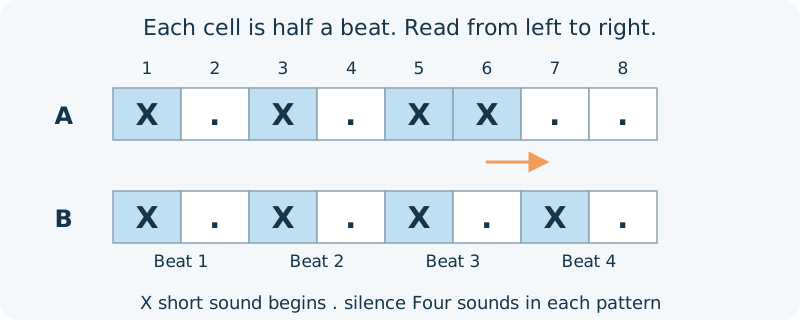
Draw eight equal boxes in a row. Each box represents half a beat, so all eight fill four beats. Write A as X . X . X X . .
Use your idea or the example below. Talk, write, draw, point or listen first. You can stop after one step.
Try it your way.
Set a clear legend
Read left to right. X means one short sound begins at the start of that half-beat cell; a dot means silence for that cell. There are no held notes in this little notation. You can simply point to each cell without making sound.
Read the first pattern
Number the cells 1 to 8. In A, sounds begin in cells 1, 3, 5 and 6. Count four sound beginnings across eight half-beat cells. The total duration is four beats.
Move one sound
Copy A as B, then move the X from cell 6 to cell 7. B is X . X . X . X . Keep the cell length and reading pace the same. Compare by tracing; gentle tapping is optional.
Explain what changed
Both patterns contain four sound beginnings and last four beats under this legend. The timing differs because one sound starts later. Keep, redraw or change the pattern; there is no performance test.
One possible version
Original pattern comparison
These two short patterns were written for this activity. They do not reproduce a song or report a listener study. One cell is half a beat, and a dot is silence.
- A: X . X . X X . . — sound beginnings in cells 1, 3, 5 and 6.
- B: X . X . X . X . — sound beginnings in cells 1, 3, 5 and 7.
- Each has four sound beginnings and eight half-beat cells: four beats. Only the sound in cell 6 moved, to cell 7.
Equal duration and equal sound count do not make the rhythms identical. No particular mood, listener preference or musical ability follows from this comparison.
Something to keep?
What stayed the same even though the rhythm changed?
You can keep a question, a sketch or a change of mind. A finished product is optional.
This opens an editable starter in your project tools. It asks before replacing open work. Choosing it does not save or share your work automatically.