
Sport & Movement · Investigate
What does a scoring rule reward?
How can the same fictional play produce different results under two scoring systems?
Apply two transparent scoring rules to the same invented action record, then ask what each rule rewards.
15–25 minutes, or one comparison for a first try. More time is optional.
Start here
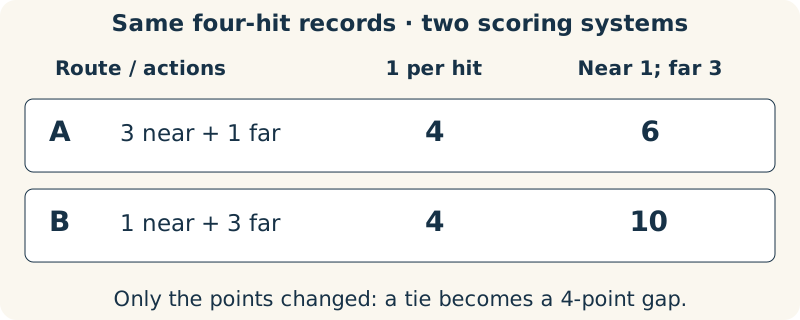
Copy two fictional four-hit records: Route A has 3 near hits and 1 far hit; Route B has 1 near hit and 3 far hits. Treat them as paper data, not real play.
Use your idea or the example below. Talk, write, draw, point or listen first. You can stop after one step.
Try it your way.
Score every hit equally
System 1 gives 1 point for any hit. A scores 3 + 1 = 4; B scores 1 + 3 = 4. Neither is ahead under this rule.
Weight one category
System 2 gives 1 point per near hit and 3 per far hit. A scores 3 × 1 + 1 × 3 = 6. B scores 1 × 1 + 3 × 3 = 10.
Explain the changed result
The actions did not change; the point mapping did. System 2 rewards far hits more strongly. State the rule beside the totals rather than presenting a score without its meaning.
Check a limit
The record has no misses, attempt difficulty or timing information. It cannot tell you which real strategy is best, whose skill is greater or whether a rule would feel fair to actual players.
One possible version
Same actions, a tie or a four-point gap
Both route records and scoring systems are original fictional examples.
- Equal-hit scoring: A = 4 and B = 4.
- Weighted scoring: A = 6 and B = 10, so B is ahead by 10−6 = 4 points.
- The totals answer different rule-defined questions. If far hits were difficult, that would need separate evidence; it is not supplied by these totals.
A score is a defined summary, not a complete description of play or a judgement of a person.
Something to keep?
Am I talking about the recorded actions, the scoring rule, or an unsupported judgement about a player?
You can keep a question, a sketch or a change of mind. A finished product is optional.
This opens an editable starter in your project tools. It asks before replacing open work. Choosing it does not save or share your work automatically.