
Sport & Movement · Explore
Explain a movement sequence on paper
What order and timing information would a diagram need?
Represent order and timing with a paper token, then find which information a sequence diagram must supply.
15–25 minutes, or one comparison for a first try. More time is optional.
Start here
Mark A (0, 0), B (2, 0) and C (2, 2) on paper. These are invented board positions in grid units, not places you need to move to.
Use your idea or the example below. Talk, write, draw, point or listen first. You can stop after one step.
Try it your way.
Read schedule 1
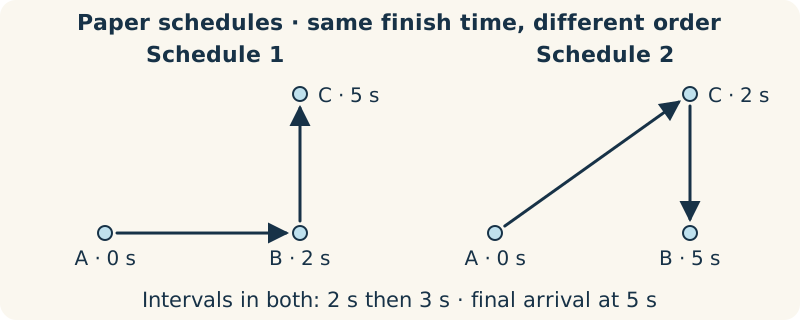
At time 0 the token is at A. It reaches B at 2 seconds and C at 5 seconds. Draw arrows A→B→C and label each arrival time.
Find the intervals
The first interval is 2−0 = 2 seconds; the second is 5−2 = 3 seconds. Arrival time 5 is not a five-second second interval.
Compare another order
Schedule 2 reaches C at 2 seconds and B at 5 seconds: A→C→B. Total time is still 5 seconds, but the intermediate position and final position differ.
Complete the instructions
Label the start, order, positions, time unit and what each time means. A dot at an arrival time does not tell you the exact movement or speed between dots.
One possible version
Equal total time, different sequence
Both schedules are fictional paper records, not exercise targets or measured performance.
- Schedule 1: A at 0 s, B at 2 s, C at 5 s. Its intervals are 2 s then 3 s.
- Schedule 2: A at 0 s, C at 2 s, B at 5 s. Its intervals are also 2 s then 3 s.
- The shared 5-second finish time does not make the sequences identical. Without more detail, several paths or timing patterns between the points could fit.
A paper schedule demonstrates how information is represented. It does not show whether a real person could or should perform a movement in that time.
Something to keep?
Have I confused a time on the clock with the duration between two events?
You can keep a question, a sketch or a change of mind. A finished product is optional.
This opens an editable starter in your project tools. It asks before replacing open work. Choosing it does not save or share your work automatically.