
Storytelling · Make
Three openings for one invented story
What does each beginning invite a reader to wonder about?
Write three different entry points to the same harmless invented event, then compare what each lets a reader know first.
15–25 minutes, or one comparison for a first try. More time is optional.
Start here
Keep these shared facts: Tavi finds a folded paper bird on an empty market table. Its wing carries a blue square. Tavi decides to ask at the map stall.
Use your idea or the example below. Talk, write, draw, point or listen first. You can stop after one step.
Try it your way.
Read the three models
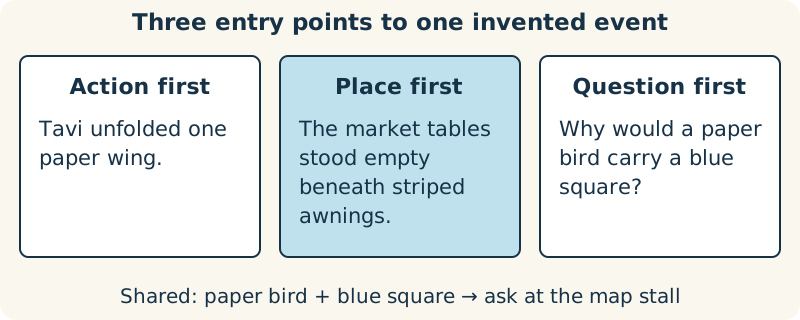
The example below begins with an action, a place or a question. Each keeps the shared facts; none is the one required opening.
Compare the first information
Underline what a reader learns first in each version. Name the question that opening leaves in play: the object’s meaning, its arrival or where Tavi will go.
Draft a different opening
Write two or three sentences, draw three frames or dictate a version. Change the entry point without adding a contradiction to the fixed facts.
Connect a next line
Add one sentence that could follow your opening. Check that its detail grows from what you have introduced rather than explaining an unrelated event.
One possible version
Three original beginnings, one event
These snippets are new Horizon fiction, not a retelling of an existing story.
- Action: “Tavi unfolded one paper wing. A blue square appeared in the crease. The map stall was still open; perhaps someone there could explain it.”
- Place: “The market tables stood empty beneath striped awnings. On the nearest table rested a paper bird with a blue square on its wing. Tavi looked towards the map stall.”
- Question: “Why would a paper bird carry a blue square? Tavi found no other mark on the folded wings. The next place to ask was the map stall.”
These are possible stylistic choices, not tested claims about what every reader finds most engaging. The story can stay unfinished.
Something to keep?
What did my opening invite the reader to wonder about, and did my next line follow that invitation?
You can keep a question, a sketch or a change of mind. A finished product is optional.
This opens an editable starter in your project tools. It asks before replacing open work. Choosing it does not save or share your work automatically.