
A little room to wonder
Archaeology & Objects
Read an object alongside its context, and distinguish a supported interpretation from an attractive guess.
Why can an object’s location matter as much as the object itself?
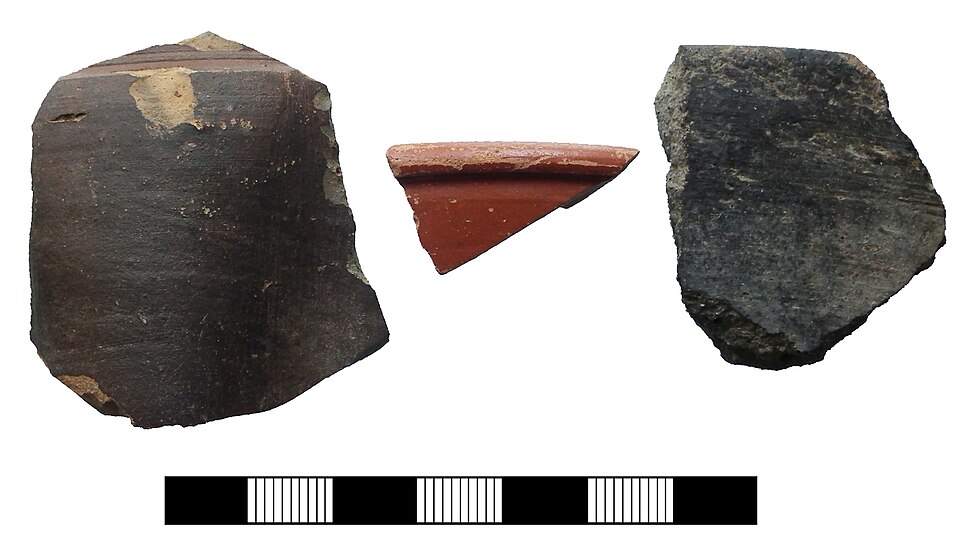
Material evidence has a context
Archaeology investigates people through material remains and their relationships. An object’s material, form and traces of use can suggest questions, but its context also matters: where it was found, what was nearby and how the surrounding deposits formed. Removing that context can remove evidence that cannot be recovered from the object alone.
Material culture includes ordinary things, not only spectacular treasures. A broken container can reveal manufacturing choices or use. It does not automatically identify its owner, explain a belief or date the whole site.
Distinguish observation and inference
For a fictional pottery fragment, “curved edge”, “red surface” and “visible grains” are observations in a description. “It was a drinking cup” is an interpretation. A curve might fit several forms, and a fragment can have been moved or reused. Compare possible explanations with evidence rather than choosing the most interesting story.
Specialists can use comparisons, manufacturing features and scientific methods to investigate age and origin. Each method has assumptions and limits. A caption identifying a museum object rests on cataloguing and research that a photograph alone does not reproduce.
Work through a contextual change
Imagine the same fictional fragment in two records. Record A places it in a sealed deposit with documented related material. Record B says only “found near the road”. The fragment’s appearance is unchanged, but A offers relationships that may help investigate its age and use; B leaves more uncertainty.
Layers can help establish relative sequences, yet deeper does not always mean older when ground has been disturbed. Ask how a deposit formed and whether objects could have moved. A tidy layered drawing is a model, not proof about a particular place.
Study without disturbing
Objects may have continuing cultural significance to living communities. A public collection image is a better starting point for this exercise than collecting or digging. Use the provider’s identification carefully and label your own questions. The goal is an evidence-based interpretation, not possession of a find.
Only if you feel like trying
Write two object labels
- Use the pottery photograph and list three visible features.
- Write one possible use as an interpretation, then give another possibility.
- Add the contextual information you would want before making a confident label.
Optional image analysis. Do not dig, remove objects, handle unknown finds or disturb cultural places.
Look at the sources.
These references informed this introduction. You can check who published them, what evidence they use and whether you would ask another question.
- National Museum of AustraliaWhat is this?
- National Museum of AustraliaArchaeology of Lake George
Research checked 1 November 2026. External pages have their own content and privacy practices.
Where could this connect?
These are editorial links between subjects. You choose which, if any, to follow.
History
Material remains contribute evidence that can complement or question written accounts.
Follow this connection
Reactions & Conservation
Changes to materials over time affect what survives and what an observer can infer.
Follow this connectionSculpture & Materials
Material, making and surface features matter when examining an object.
Follow this connection