
Biology · Explore
Where a cell analogy stops working
How can an everyday comparison explain a cell without becoming misleading?
Use a workshop analogy to explain selected plant-cell structures, then mark where the comparison fails.
15–25 minutes, or one comparison for a first try. More time is optional.
Start here
Use three reference facts: the cell wall gives support, the membrane regulates exchange, and chloroplasts carry out photosynthesis in photosynthetic plant cells.
Use your idea or the example below. Talk, write, draw, point or listen first. You can stop after one step.
Try it your way.
Build a useful mapping
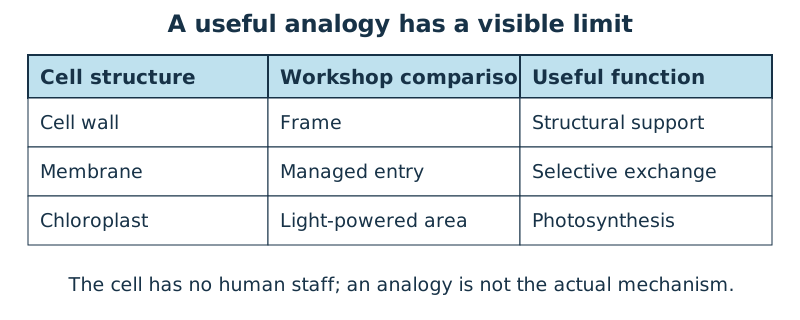
Compare a cell wall with a workshop frame, the membrane with managed entry points, and chloroplasts with a light-powered production area. Each pairing describes one function, not a complete identity.
Explain one link
Choose a pair and say what it helps explain. A frame can support a space; that makes support a useful connection to the cell wall.
Find a break in the analogy
A workshop has people making decisions. A cell membrane has no receptionist deciding what to admit, and a chloroplast is not a person or an electrical solar panel.
Improve the label
Write ‘helps explain…’ and ‘does not mean…’ beside your chosen pair. Keep a comparison, revise it or choose a different everyday model.
One possible version
Constructed analogy: a plant cell as a workshop
Only selected functions are compared. The factual labels concern cell structures; the workshop is invented.
- Cell wall ↔ frame: useful for structural support.
- Membrane ↔ managed entry: useful for selective exchange, but no conscious gatekeeper exists.
- Chloroplast ↔ light-powered production: photosynthesis makes sugars; a solar panel making electricity is not the same process.
An analogy does not reproduce a cell’s size, chemistry or all its structures. Not every plant cell contains chloroplasts.
Something to keep?
Did my comparison make a function clearer while keeping its limits visible?
You can keep a question, a sketch or a change of mind. A finished product is optional.
This opens an editable starter in your project tools. It asks before replacing open work. Choosing it does not save or share your work automatically.