
Ecology · Investigate
Map a fictional microhabitat
Which small differences would be useful to record before making an explanation?
Read a complete fictional map with equal sampling squares, then separate a pattern in the record from its cause.
15–25 minutes, or two squares for a first try. More time is optional.
Start here
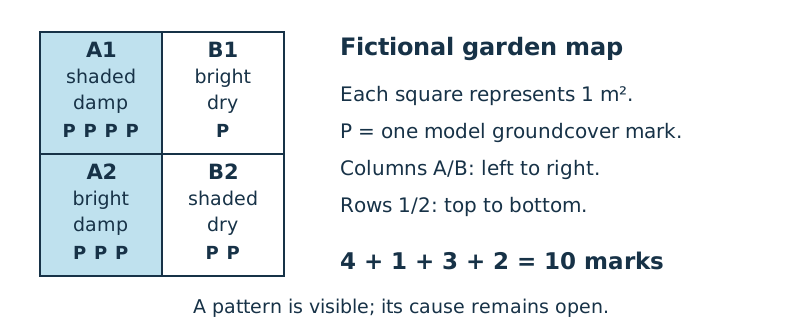
Use a 2-by-2 map: top row A1, B1; bottom row A2, B2. Each square represents 1 m² of a fictional garden, with counts of a model groundcover P.
Use your idea or the example below. Talk, write, draw, point or listen first. You can stop after one step.
Try it your way.
Read the full key
A1 is shaded, damp, 4 P; B1 bright, dry, 1 P; A2 bright, damp, 3 P; B2 shaded, dry, 2 P. Counts, light descriptions and moisture labels are supplied model data.
Compare like areas
All four squares represent the same area and use the same counting rule. Add the counts if wanted: 4+1+3+2 = 10 P marks across the model.
Describe one pattern
The two damp squares contain 4 and 3 marks; the two dry squares 1 and 2. Describe that contrast without claiming dampness caused it.
Plan a better question
Ask what repeated records, dates or other conditions would help examine the pattern. You can keep this a plan without going outside or identifying a real plant.
One possible version
Invented map: four equal squares
Columns A and B run left to right; rows 1 and 2 run top to bottom. P means one model groundcover mark, not a verified species.
- Top: A1 shaded/damp/4 P; B1 bright/dry/1 P.
- Bottom: A2 bright/damp/3 P; B2 shaded/dry/2 P.
- There are 10 P marks altogether; the two damp squares have higher counts in this supplied model.
Four invented squares do not prove a habitat preference or causal effect. Different areas, counting rules or unrecorded conditions would affect a real comparison.
Something to keep?
Did I keep the area and counting rule attached to the numbers?
You can keep a question, a sketch or a change of mind. A finished product is optional.
This opens an editable starter in your project tools. It asks before replacing open work. Choosing it does not save or share your work automatically.