
Engineering · Investigate
A flow network on paper
What does a branching network allow, and where could a bottleneck appear?
Use drawn tokens to explore a branching network with a limited capacity.
10–20 minutes, or one small comparison for a first try. More time is optional.
Start here
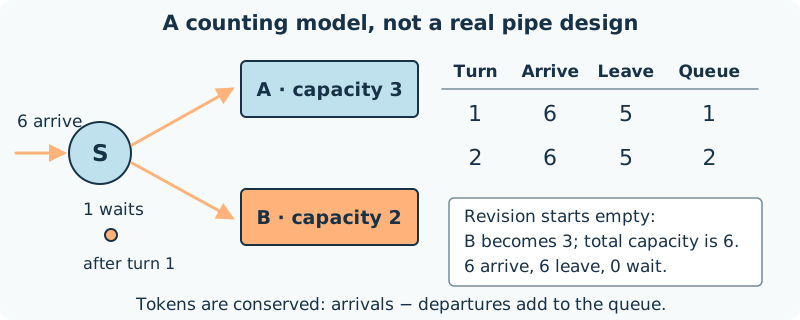
Draw a source S feeding two branches A and B. Write: six tokens arrive each turn.
Use your idea or the example below. Talk, write, draw, point or listen first. You can stop after one step.
Try it your way.
State the rules
Branch A can pass at most three tokens per turn; B can pass at most two. Tokens do not disappear or jump a branch.
Trace one turn
Send six tokens to S. Move three along A and two along B. Mark the remaining token as waiting at S.
Trace another turn
Add six new tokens. There are now seven waiting or arriving; five can leave. Two remain. Record arrivals, departures and the queue.
Change one limit
Raise B’s capacity to three in a fresh model. From an empty start, all six incoming tokens can leave each turn. Explain the difference.
One possible version
Original model: two display channels
The tokens and turns are invented counting units, not measurements from a water system.
- Original limits: 3 + 2 = 5 departures for 6 arrivals; one token is left after turn 1.
- Turn 2 starts with 1 waiting plus 6 new tokens. Five leave and 2 remain.
- With B changed to 3, total capacity is 6. An empty-start turn has 6 arrivals, 6 departures and no queue.
Real water networks involve pressure, losses and other constraints. A token model cannot establish safe pipe sizes or real flow rates.
Something to keep?
Did I keep every token accounted for?
You can keep a question, a sketch or a change of mind. A finished product is optional.
This opens an editable starter in your project tools. It asks before replacing open work. Choosing it does not save or share your work automatically.