
Games · Make
A maze with a readable clue
How can a clue help a player without silently solving the puzzle?
Create a small grid puzzle and choose a clue that leaves room to explore.
10–20 minutes, or one small comparison for a first try. More time is optional.
Start here
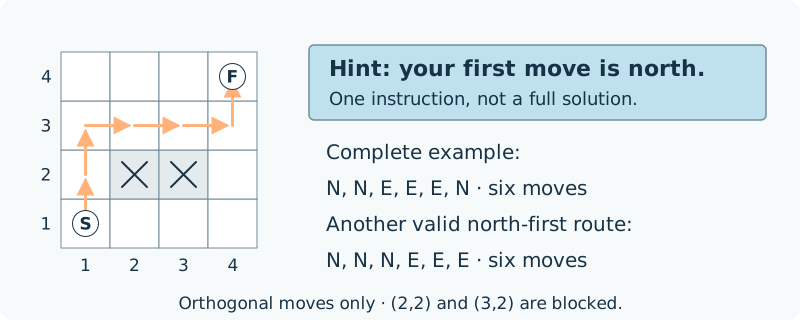
Draw a 4 by 4 grid. Mark start (1,1), finish (4,4), and blocked squares (2,2) and (3,2).
Use your idea or the example below. Talk, write, draw, point or listen first. You can stop after one step.
Try it your way.
State movement
Move one square north, south, east or west. Do not enter a blocked square or jump diagonally. The bottom-left cell is (1,1).
Find a route
Trace a route before writing a clue. One example is north, north, east, east, east, north: six moves to the finish.
Choose a clue
Try ‘Your first move is north.’ This removes the east-first option, but does not list every move. Find two routes that still fit it.
Check the information
Compare that clue with the complete route. Decide whether your player should receive a hint, a full solution or neither; label each honestly.
One possible version
Original model: a clue with choices left
The grid and routes are invented paper examples, not records of playtesting.
- Example route: (1,1), (1,2), (1,3), (2,3), (3,3), (4,3), (4,4).
- Another north-first route goes up to (1,4), then across to (4,4). Both take six moves.
- The clue fixes only the first move. It does not select one unique complete route.
This grid maze has blocked cells and more than one valid route. A checked example does not establish ideal difficulty for every player.
Something to keep?
Does my hint support a choice, or has it already supplied the whole answer?
You can keep a question, a sketch or a change of mind. A finished product is optional.
This opens an editable starter in your project tools. It asks before replacing open work. Choosing it does not save or share your work automatically.