
History · Investigate
A timeline with honest gaps
How can I order supplied records while making missing information visible?
Order supplied fictional records without turning missing dates into facts.
10–20 minutes, or one small comparison for a first try. More time is optional.
Start here
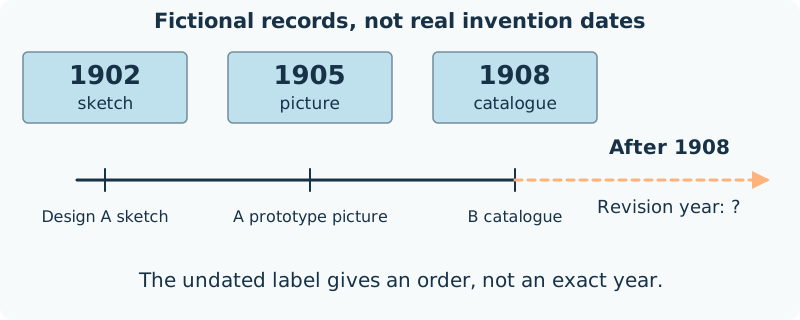
Write four record cards: 1902 sketch, 1905 picture, 1908 catalogue, and an undated revision label.
Use your idea or the example below. Talk, write, draw, point or listen first. You can stop after one step.
Try it your way.
Read the records
The sketch shows design A; the picture shows an A prototype; the catalogue offers design B. The last label says revised after the 1908 catalogue.
Place dated items
Put 1902, 1905 and 1908 in order. These dates belong to the fictional records, not necessarily to the first invention of either design.
Place the uncertain item
The revision must come after the 1908 catalogue under the supplied label. Use a dashed area after 1908 rather than assigning a guessed year.
Write an honest caption
State what is dated, what order is supported and what remains unknown. You can leave the timeline unfinished.
One possible version
Original records: a made-up display stand
The dates, designs and record labels are invented for this exercise.
- 1902: a design A sketch. 1905: a picture of an A prototype. 1908: a catalogue offering design B.
- The undated label says revised after the 1908 catalogue, so it belongs somewhere later than that catalogue.
- The exact revision year and the original invention date are not supplied.
The earliest surviving record in a set is not automatically the date something was invented. The fictional cards are not historical evidence about a real product.
Something to keep?
Have I given an unknown event a date that the records do not supply?
You can keep a question, a sketch or a change of mind. A finished product is optional.
This opens an editable starter in your project tools. It asks before replacing open work. Choosing it does not save or share your work automatically.