
Philosophy · Investigate
A claim, a reason and a question
What would make an invented explanation stronger or weaker?
Use four invented machine records to separate a claim, its supporting reason and the question that could change it.
15–25 minutes, or one comparison for a first try. More time is optional.
Start here
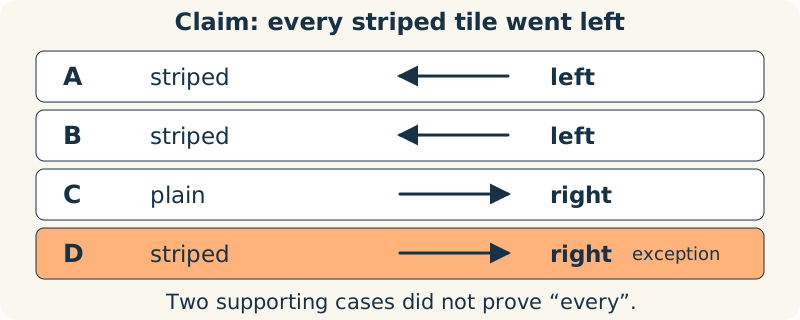
Copy this fictional record: striped tile A went left; striped tile B went left; plain tile C went right. The machine is only a drawing.
Use your idea or the example below. Talk, write, draw, point or listen first. You can stop after one step.
Try it your way.
Name the claim
Write: “Every striped tile goes left.” Underline “every”. This claims more than the three listed records: it covers striped tiles not yet shown.
Give the reason accurately
A and B support the claim because both are striped and went left. C says something about a plain tile, so it does not settle what every striped tile does.
Use a new supplied record
Now add invented tile D: striped, went right. Check whether it belongs to the claim’s category and whether its result conflicts. D does both, so the “every” claim fails for this record set.
Revise and ask
A defensible replacement is: “A and B went left; D did not.” Ask what feature or rule might explain the different result. Do not invent an unseen mechanism as an established fact.
One possible version
A reason can support a claim without proving it
A, B, C and D are constructed examples, not observations from a real machine.
- Before D: A and B are positive cases, but checking two striped tiles does not establish an unrestricted “every” claim.
- After D: a striped tile went right. One genuine conflicting case defeats the claim as stated.
- Revised report: 2 of the 3 supplied striped tiles went left. That is a description of these records, not a prediction for all possible tiles.
Changing a claim to fit records is different from discovering why the records occurred. The hidden rule remains unspecified.
Something to keep?
Did I change my confidence because of evidence, or quietly change what my claim meant?
You can keep a question, a sketch or a change of mind. A finished product is optional.
This opens an editable starter in your project tools. It asks before replacing open work. Choosing it does not save or share your work automatically.