
Philosophy · Investigate
Find a shape that breaks a rule
What can one clear counterexample show about an ‘all’ claim?
Check an “all” claim with three constructed shape cards, then write exactly what one exception establishes.
15–25 minutes, or one comparison for a first try. More time is optional.
Start here
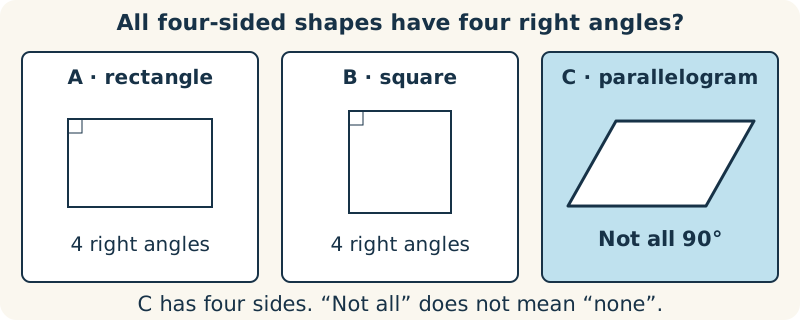
Draw A as a rectangle, B as a square and C as a slanted parallelogram. Keep all three closed and four-sided.
Use your idea or the example below. Talk, write, draw, point or listen first. You can stop after one step.
Try it your way.
State the rule to test
Use this claim: “All four-sided shapes have four right angles.” A right angle is 90°. The claim concerns every quadrilateral, not just rectangles.
Sort support and contradiction
A and B fit the claim. C has two pairs of parallel sides but slanted corners, so not all of its angles are right angles. It still has four sides, so it is a relevant counterexample.
Repair the scope
A true narrower statement is: “Rectangles have four right angles.” Squares are rectangles with equal sides. The change is to the named category, not to the shape C.
Say what has not followed
C does not show that no quadrilateral has right angles: A and B already do. Keep “not all” separate from “none”.
One possible version
One exception is enough for an “all” claim
These three original drawings are examples chosen to test the stated rule.
- A rectangle and B square both have four right angles. Two fitting examples cannot establish the universal claim.
- C is a parallelogram with oblique, not right, corners. It is four-sided, so it falls inside the claim but fails its stated property.
- Conclusion: not every quadrilateral has four right angles. This says nothing about how common each shape is.
A sketch must show the intended properties clearly. A triangle would be irrelevant here because it has only three sides.
Something to keep?
Have I shown both that my example belongs to the category and that the claimed property fails?
You can keep a question, a sketch or a change of mind. A finished product is optional.
This opens an editable starter in your project tools. It asks before replacing open work. Choosing it does not save or share your work automatically.