
Physics · Investigate
Read an invented friction comparison
Which variables need controlling before a surface comparison is useful?
Read a completely invented steady-pull table, calculate its averages and identify what a real comparison would need to hold consistent.
15–25 minutes, or one table row for a first try. More time is optional.
Start here
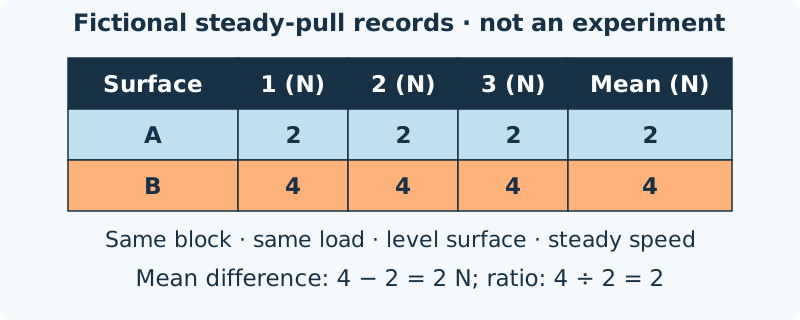
Copy this invented record in newtons (N): surface A, 2, 2, 2; surface B, 4, 4, 4. The model uses the same sliding block at steady speed on a level surface.
Use your idea or the example below. Talk, write, draw, point or listen first. You can stop after one step.
Try it your way.
State the model conditions
Assume the same block, contact face, added load, level track and steady speed for both surface labels. Each entry represents the horizontal pull needed to balance sliding friction in this simplified model.
Read and calculate
There are three fictional entries per surface. A averages (2 + 2 + 2) ÷ 3 = 2 N. B averages (4 + 4 + 4) ÷ 3 = 4 N. Keep the unit beside each result.
Make a bounded comparison
In this table, B needs 2 N more pull and twice A’s average pull. These labels do not identify real materials. The table does not establish that a rough-looking surface always has a larger friction force.
Identify missing evidence
Name one condition that would need checking in a real investigation, such as a consistent load or speed. Do not turn invented entries into actual observations. You can finish by annotating the supplied table.
One possible version
Fictional steady-pull records
All six numbers were invented to practise reading a controlled comparison. Horizon did not perform a friction experiment.
- Surface A: 2, 2, 2 N; mean = 2 N. Surface B: 4, 4, 4 N; mean = 4 N.
- Difference of the means: 4 − 2 = 2 N. Ratio: 4 ÷ 2 = 2.
- At the assumed steady speed, the forward pull and backward sliding-friction force balance. Equal opposite forces do not mean the block is stationary.
This model does not measure a coefficient of friction, test named materials or establish measurement precision. Real records can vary; constant invented numbers are not evidence of perfect measurement.
Something to keep?
Am I describing what the invented records say, or claiming an experiment happened?
You can keep a question, a sketch or a change of mind. A finished product is optional.
This opens an editable starter in your project tools. It asks before replacing open work. Choosing it does not save or share your work automatically.