
Physics · Explore
Explain a drawn shadow
How can a ray diagram show what a shadow model assumes?
Use a complete point-source drawing to locate a shadow region and explain what an ideal ray model leaves out.
15–25 minutes, or two rays for a first try. More time is optional.
Start here
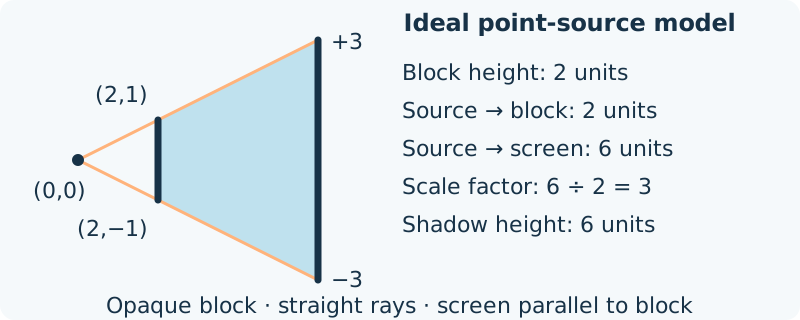
Use a drawn point source at (0, 0), an opaque vertical block at x = 2 from y = −1 to 1, and a parallel screen at x = 6. All coordinates use the same arbitrary unit.
Use your idea or the example below. Talk, write, draw, point or listen first. You can stop after one step.
Try it your way.
Draw the boundary rays
Join the source to the block’s top (2, 1) and bottom (2,−1). Continue each straight line to the screen. These construction lines just skim the edges; they do not pass through the block.
Find the shadow limits
The screen is three times as far from the source as the block: 6 ÷ 2 = 3. The upper boundary reaches y = 3 and the lower y = −3, so the ideal shadow height is 6 units.
Label the assumptions
State point source, opaque block, straight rays in one uniform medium, parallel screen and no other illumination. Mark the region between the boundaries on the screen as missing direct light.
Explain one limit
A large real light source, surrounding reflected light or different geometry can give a different or blurred boundary. Keep this a paper model; it is not a photograph or a test of an actual lamp.
One possible version
Constructed ray model: a threefold scale factor
The coordinates and diagram are original ideal geometry, not experimental observations. Source-to-block distance is 2 units; source-to-screen distance is 6.
- Upper boundary: y/x = 1/2, so at x = 6, y = 3. Lower boundary: y/x = −1/2, so y = −3.
- The block’s height is 1 − (−1) = 2 units. The screen’s ideal shadow height is 3 − (−3) = 6 units.
- The height ratio is 6 ÷ 2 = 3. The shadow is a region with direct light blocked, not a second object travelling from the block.
A point source is an idealisation. This two-dimensional construction does not include an extended source, scattering, diffraction or ambient reflected light.
Something to keep?
Which features belong to this ideal drawing rather than every real shadow?
You can keep a question, a sketch or a change of mind. A finished product is optional.
This opens an editable starter in your project tools. It asks before replacing open work. Choosing it does not save or share your work automatically.