
Sport & Movement · Make
Design a game with more than one way to join
Which rule changes create a real participation choice?
Design a paper game in which the objective stays clear while the way someone communicates a move can change. No physical game or group is required.
15–25 minutes, or one comparison for a first try. More time is optional.
Start here
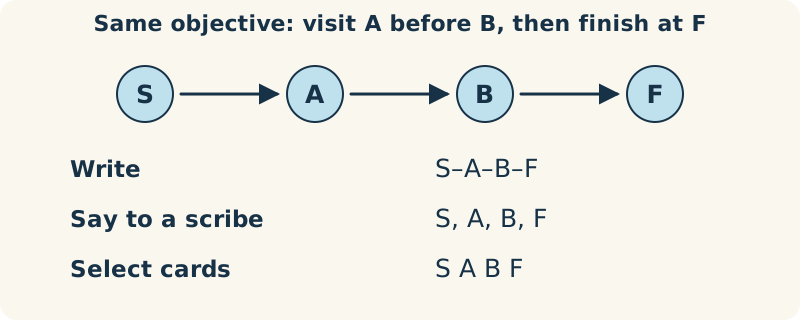
Draw a route of boxes S → A → B → F. The paper-game objective is to visit A then B before finishing at F.
Use your idea or the example below. Talk, write, draw, point or listen first. You can stop after one step.
Try it your way.
Spot the unnecessary restriction
An invented first rule says “Only written letter sequences count.” It ties a planning task to one way of reporting it. Identify that restriction without guessing anyone’s abilities.
Offer equivalent choices
A revised rule accepts writing S-A-B-F, saying the letters to a scribe, or selecting the ready-made letter cards in order. Every mode must communicate the same complete route.
Check the objective stays fixed
Trace each offered version. All three must visit A before B and finish at F. Changing the communication method does not quietly remove a required stop for only one mode.
Ask about a remaining barrier
Could the letters, directions or recording arrangement still be unclear? Propose one practical change, such as larger cards or read-aloud labels. A proposed option is not proof it suits everyone.
One possible version
Three ways to report the same planned route
This is an invented desk-game plan, not a report of a participant trial.
- Written: S-A-B-F. Spoken to a chosen scribe: “S, A, B, F.” Selected cards: S then A then B then F.
- Each communicates the same four positions. The objective, available route and order stay unchanged.
- A learner may inspect the worked route without playing. Independent use does not require a team, timer, movement task or performance score.
Real access preferences need to be asked about, not diagnosed from this model. The plan is not universal accessibility certification.
Something to keep?
Did I create a genuine choice, or give one option less information or a different objective?
You can keep a question, a sketch or a change of mind. A finished product is optional.
This opens an editable starter in your project tools. It asks before replacing open work. Choosing it does not save or share your work automatically.