
Storytelling · Make
The same small event from two viewpoints
Which details change when an invented narrator changes?
Give two invented narrators different access to one small event. Separate what they can observe from what they merely suppose.
15–25 minutes, or one comparison for a first try. More time is optional.
Start here
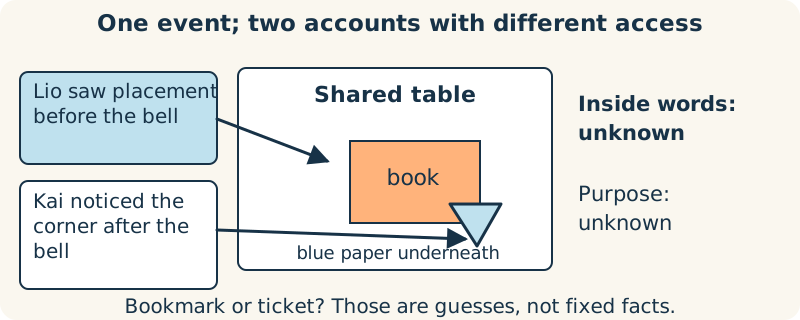
Use this fixed event: Renn puts folded blue paper under a book on a table. A bell rings. Lio saw the placement from a window; Kai notices only the corner after the bell.
Use your idea or the example below. Talk, write, draw, point or listen first. You can stop after one step.
Try it your way.
Track who could know what
Lio saw the paper arrive but cannot read inside it. Kai did not see its arrival. Both can notice the blue corner; neither has been told Renn’s purpose.
Read the two voices
Compare the supplied first-person versions. “Perhaps a bookmark” and “looked like a ticket” are guesses, not new facts the writer has established.
Write within one viewpoint
Add a sentence for Lio or Kai that preserves the fixed event and that narrator’s access. You may describe visible detail or a labelled guess; do not silently give them hidden knowledge.
Check the reader’s picture
Mark observation and inference differently. If you switch narrators, signal the change so a reader can follow whose knowledge is available.
One possible version
Two tellings without changing the event
Renn, Lio and Kai are fictional; no real scene or private note is being described.
- Lio: “From the window I saw Renn slide folded blue paper under the book. Then the bell rang. I could not read the paper. Perhaps it was a bookmark.”
- Kai: “The bell rang before I noticed a blue corner under the book. From my seat I had not seen it arrive. It looked like a ticket, but I could not be sure.”
- Kai noticed later; this does not mean the paper arrived later. A change in telling need not be a change in the event itself.
First person does not make an inference true, and third person does not automatically mean a narrator knows everything. Choose and maintain the access you establish.
Something to keep?
Did I change the viewpoint, or accidentally change what happened?
You can keep a question, a sketch or a change of mind. A finished product is optional.
This opens an editable starter in your project tools. It asks before replacing open work. Choosing it does not save or share your work automatically.