
Art · Make
A texture made of marks
How can repeated marks suggest a surface without copying a photograph?
Use repeated lines to suggest a surface, then show what changed in the arrangement.
10–20 minutes, or one comparison for a first try. More time is optional.
Start here
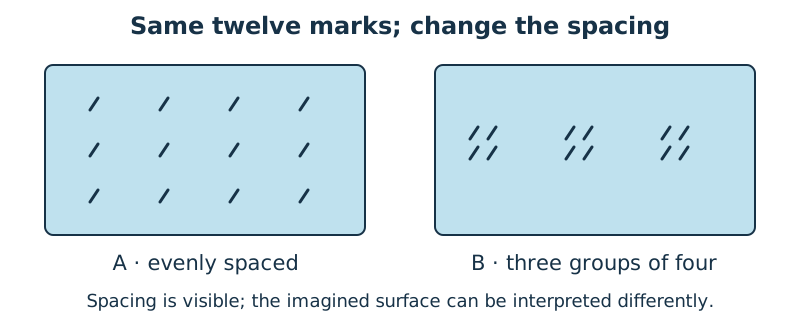
Look at the two supplied patches: each contains 12 short slanting marks. A spaces them evenly; B gathers them into three groups of four.
Use your idea or the example below. Talk, write, draw, point or listen first. You can stop after one step.
Try it your way.
Choose a mark
Draw one small slanting line, or use the supplied mark. Repeat it 12 times in a rectangular patch without trying to depict a real object.
Rearrange the same marks
Make a second patch with 12 similar lines gathered into three groups of four. Keep the mark size and direction similar; change the spacing.
Describe a possible texture
Name a visible feature first: ‘three tight groups’. Then suggest a surface it could evoke. A drawing can suggest roughness without its paper actually becoming rough.
Keep a useful comparison
Label the two patches and choose which arrangement you would develop, if either. You can also explain the example without making your own.
One possible version
Original model: twelve marks, two arrangements
These invented patches compare mark spacing. They do not copy a photograph or show a measured physical surface.
- A contains 12 evenly spaced slanting marks.
- B contains the same 12 marks in three groups of four.
- ‘More clustered’ describes B; ‘looks bark-like’ is one possible interpretation.
Spacing can suggest texture, but this pair does not show that every viewer sees the same surface or that the paper has changed texture.
Something to keep?
Which part was visible spacing, and which part was an imagined surface?
You can keep a question, a sketch or a change of mind. A finished product is optional.
This opens an editable starter in your project tools. It asks before replacing open work. Choosing it does not save or share your work automatically.