
Biology · Explore
Compare two leaf diagrams
Which features are visible and which functions need a reference?
Compare two original leaf diagrams and distinguish visible lines from a biological function explained by a reference.
10–20 minutes, or one pair for a first try. More time is optional.
Start here
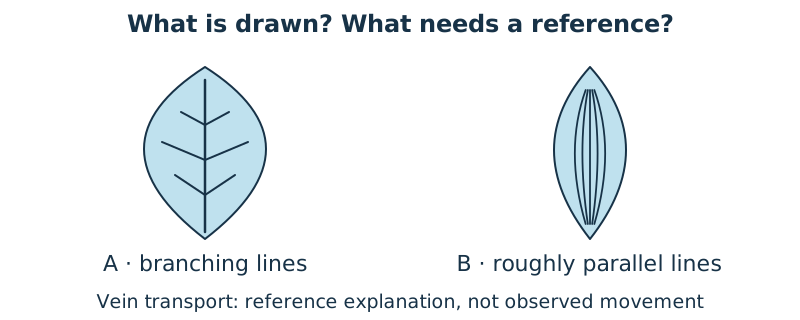
Compare A, a broad leaf outline with a central line and branching side lines, and B, a narrow outline with several roughly parallel lines.
Use your idea or the example below. Talk, write, draw, point or listen first. You can stop after one step.
Try it your way.
Record the visible pattern
Describe line arrangements and outline shape before naming a plant. The drawings are simplified designs, not collected leaves or species records.
Use one reference fact
Leaf veins contain vascular tissue involved in transport. The visible pattern can be described in a diagram; its function is reference knowledge, not something the drawing alone demonstrates.
Make two kinds of label
Put ‘drawn feature’ beside a line you can see and ‘reference explanation’ beside the transport statement. Keep the categories separate.
Leave identification open
Write one question the diagrams cannot answer, such as the plant’s species or growing place. You can sketch another labelled model without answering it.
One possible version
Original diagrams: branching and parallel lines
A and B are constructed leaf diagrams; they are not photographs or full botanical identification keys.
- A: a broad outline with a central line and branching side lines.
- B: a narrow outline with roughly parallel lengthways lines.
- Vein transport is a reference explanation; no water movement is observed in either drawing.
A line pattern can support a description, but these simple models do not identify a species or measure a leaf’s function.
Something to keep?
Which sentence described the diagram, and which relied on a reference?
You can keep a question, a sketch or a change of mind. A finished product is optional.
This opens an editable starter in your project tools. It asks before replacing open work. Choosing it does not save or share your work automatically.