
Chemistry · Investigate
Plan a separation on paper
Which property would a proposed separation use, and what remains assumed?
Trace a paper filter model and explain why removing visible solids would not remove a dissolved substance.
10–20 minutes, or one trace for a first try. More time is optional.
Start here
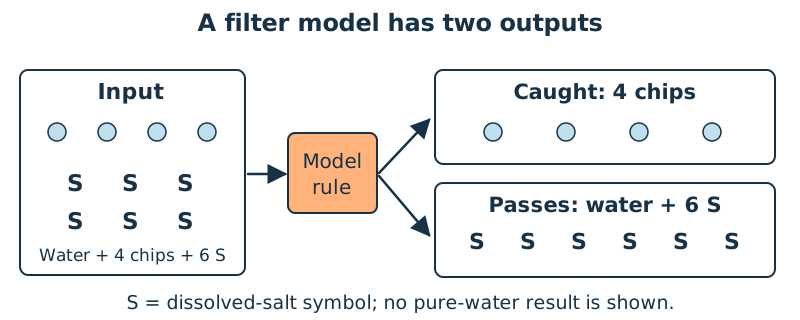
Use a fictional mixture diagram containing four large blue chip symbols and six S symbols for dissolved salt in water. All of it stays on paper.
Use your idea or the example below. Talk, write, draw, point or listen first. You can stop after one step.
Try it your way.
State the model rules
In this supplied model, a filter catches the large chips but allows water and the dissolved salt to pass. These are declared model rules, not results of a performed test.
Trace both outputs
Move or redraw all four chip symbols into ‘caught by filter’. Put all six S symbols with the water in ‘passes through’. Keep each kind of symbol accounted for.
Name what remains mixed
The passed-through liquid still contains dissolved salt. Removing the visible chips does not turn it into pure water or make it suitable to drink.
Keep a next method separate
If separating salt from water is a new goal, it needs a different justified process. State that question without heating, evaporating or trying anything physically.
One possible version
Constructed filter model: account for both parts
The four chip symbols represent an insoluble large-particle component; the six S symbols mark portions of dissolved salt, not individual molecules.
- Input: four chips plus water containing six S symbols.
- Caught: four chips. Passed through: water containing all six S symbols.
- The model separates the chips, while the salt-water mixture remains.
Actual filtration depends on material properties and filter size. This diagram is not a water-treatment instruction or a claim that a real filter was tested.
Something to keep?
Did every symbol reach an output, and did I confuse clear-looking with pure?
You can keep a question, a sketch or a change of mind. A finished product is optional.
This opens an editable starter in your project tools. It asks before replacing open work. Choosing it does not save or share your work automatically.