
Film & Animation · Make
Tell a small story in six shots
What information does each frame give the viewer?
Plan a small invented object story using six labelled frames.
10–20 minutes, or one small comparison for a first try. More time is optional.
Start here
Draw six empty boxes and choose a paper star as the fictional subject.
Use your idea or the example below. Talk, write, draw, point or listen first. You can stop after one step.
Try it your way.
Choose a tiny change
Use the supplied story: a paper star moves from a table into a display frame. Decide what is different at the end.
Plan six shots
Sketch the table and frame, a closer view of the star, its approach, its entry, its placement and the finished display. Rough shapes are enough.
Name the information
Under each panel, write what the viewer can learn. Mark wide, mid or close views when the distinction helps.
Check the sequence
Read the panels in order. Point to any missing connection or repeated information. Keep, replace or leave out a panel if you explain why.
One possible version
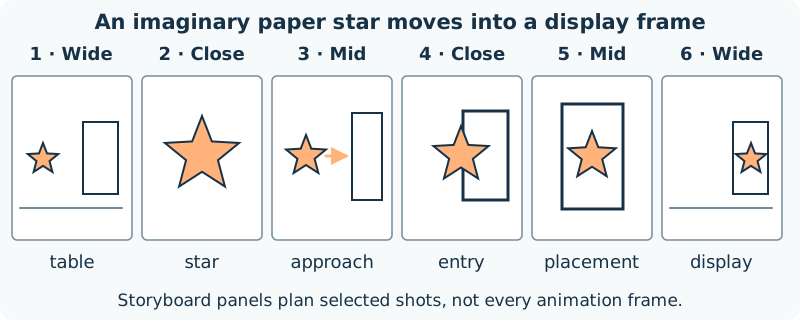
Original storyboard: a star display
The six drawings plan an imaginary sequence. They are not stills from a real film.
- 1 wide: a star and an empty frame are on a table. 2 close: the star is the subject.
- 3 mid: the star approaches the frame. 4 close: it slides into the opening.
- 5 mid: the star sits inside. 6 wide: the finished display connects back to the table.
A storyboard plans selected shots, not every animation frame. It does not guarantee what an audience understands.
Something to keep?
What does each frame contribute to the small story?
You can keep a question, a sketch or a change of mind. A finished product is optional.
This opens an editable starter in your project tools. It asks before replacing open work. Choosing it does not save or share your work automatically.