
Games · Investigate
Change one movement rule
What changes when a puzzle allows diagonal moves?
Compare two versions of a complete paper puzzle. Keep the board and goal the same while changing the allowed movement.
10–20 minutes, or one route for a first try. More time is optional.
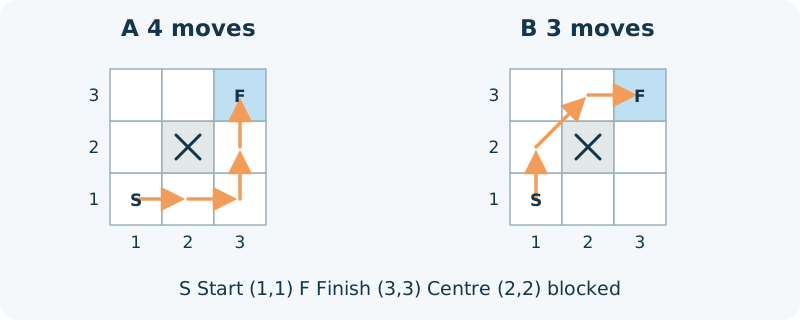
Start here
Draw a 3-by-3 grid. Number columns 1 to 3 from left to right and rows 1 to 3 from bottom to top. Mark Start at (1,1), Finish at (3,3) and block (2,2).
Use your idea or the example below. Talk, write, draw, point or listen first. You can stop after one step.
Try it your way.
Agree the first rule
Begin at Start. One move goes one square up, down, left or right. Stay inside the grid and never land on the blocked square. The goal is to reach Finish; there is no timer.
Record a route
Trace a route and count moves between squares, not the number of squares visited. The supplied four-move route works if you prefer to examine a complete example.
Change only movement
Now also allow a move to a diagonally adjacent square. Passing a corner is allowed in this version; landing on (2,2) remains forbidden. Keep the same Start, Finish and board. Find or trace a route again.
Explain a consequence
Compare your routes. Name what the new rule permits. A shorter route may be interesting, but you can also discuss which choices change or whether you would prefer another rule.
One possible version
Worked puzzle: four moves or three
This is a constructed puzzle with exact rules, not a study of player preferences. Coordinates identify squares as (column,row).
- Up/down/left/right: (1,1) → (2,1) → (3,1) → (3,2) → (3,3). Four moves.
- With diagonals: (1,1) → (1,2) → (2,3) → (3,3). Three moves; no landing on the centre.
- Two diagonal moves would pass through (2,2), so they do not solve this board under the stated rule.
These paths demonstrate the stated puzzle. They do not show that diagonal movement makes every game easier, fairer or more enjoyable.
Something to keep?
Which difference came from the rule, and which came from the route I chose?
You can keep a question, a sketch or a change of mind. A finished product is optional.
This opens an editable starter in your project tools. It asks before replacing open work. Choosing it does not save or share your work automatically.