
History · Investigate
An object and three possible explanations
Which details support an explanation of an invented historical object?
Compare possible uses of a completely invented object while keeping observation separate from a guess.
10–20 minutes, or one small comparison for a first try. More time is optional.
Start here
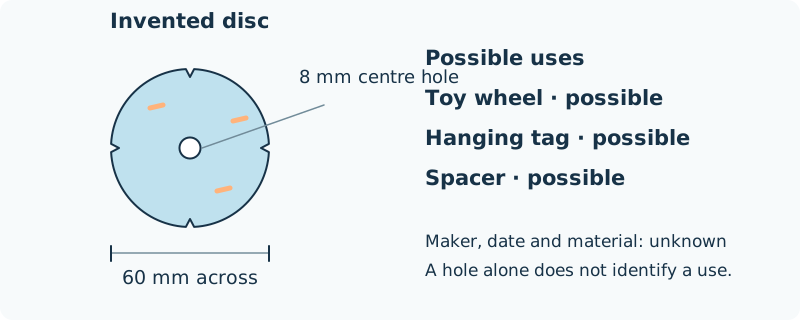
Use the supplied drawing of a 60 mm disc with an 8 mm centre hole, four edge notches and worn paint.
Use your idea or the example below. Talk, write, draw, point or listen first. You can stop after one step.
Try it your way.
Describe first
List the round outline, hole, notches and paint wear without naming a function or date. These details are supplied fictional observations.
Offer explanations
Try toy wheel, hanging tag and spacer. More than one explanation can fit a centre hole; you may add or reject a possibility.
Match clues cautiously
A centre hole and edge wear could fit a toy wheel, but neither proves one. A hanging tag or spacer can also have a hole.
Choose a next check
Suggest a useful record or test, such as a matching axle drawing with dimensions. Do not invent that evidence or claim the object’s age.
One possible version
Original example: an unidentified disc
This is an invented object drawing, not an artefact or a discovery from a real place.
- Observed: 60 mm across, 8 mm centre hole, four edge notches and worn paint.
- Tentative idea: a toy wheel, supported weakly by the hole and wear.
- Alternative: a tag or spacer could share those details. A matching dimensioned parts record would be useful.
No supplied detail identifies the maker, date, material or actual use. A plausible explanation remains a hypothesis.
Something to keep?
Where did I move from describing a clue to interpreting it?
You can keep a question, a sketch or a change of mind. A finished product is optional.
This opens an editable starter in your project tools. It asks before replacing open work. Choosing it does not save or share your work automatically.