
History · Investigate
Separate a picture from its caption
Which claim comes from visible detail and which depends on a record?
Compare what an original drawing shows with claims supplied by a separate caption.
10–20 minutes, or one small comparison for a first try. More time is optional.
Start here
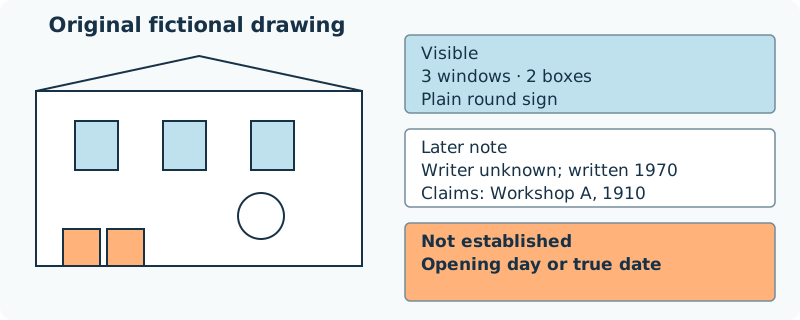
Look at the invented workshop drawing: three windows and two boxes beside a plain round sign.
Use your idea or the example below. Talk, write, draw, point or listen first. You can stop after one step.
Try it your way.
Record visible details
Describe the windows, boxes and sign. The drawing itself contains no readable date or place name.
Read a separate label
A fictional note written in 1970 calls the scene Workshop A, 1910. Its writer is unknown. This is a record claim, not something visible in the drawing.
Test another caption
Try Opening day at Workshop A. Nothing supplied establishes an opening day. Label that phrase unconfirmed rather than treating it as an observation.
Write a careful label
Combine a visible description with the attributed note and its uncertainty. A short label can still make the evidence boundary clear.
One possible version
Original model: a drawing and a later note
The picture, workshop, dates and note are all fictional; this is not an archival photograph.
- Visible: three windows, two boxes and a plain circular sign.
- Supplied note: an unknown writer in 1970 labelled the scene Workshop A, 1910.
- Not established: whether 1910 is correct or whether the scene shows an opening day.
A later caption can be useful but is not automatically accurate. Appearance alone does not supply the maker, location or date.
Something to keep?
Did my caption make an interpretation look like a visible fact?
You can keep a question, a sketch or a change of mind. A finished product is optional.
This opens an editable starter in your project tools. It asks before replacing open work. Choosing it does not save or share your work automatically.