
Mathematics · Make
A tiling pattern with a rule
How can a repeated shape cover a region without gaps or overlaps?
Cover a small drawn region with repeated two-square tiles, then explain why a count alone is not a complete proof.
15–25 minutes, or one row for a first try. More time is optional.
Start here
Draw a rectangle with 6 equal columns and 4 equal rows. One little square is one unit of area. Your tile is a domino covering two neighbouring squares.
Use your idea or the example below. Talk, write, draw, point or listen first. You can stop after one step.
Try it your way.
State the rule
Use whole dominoes only. Each must cover exactly two side-by-side unit squares. Tiles may turn, but cannot overlap, cross the boundary or leave gaps.
Make a complete arrangement
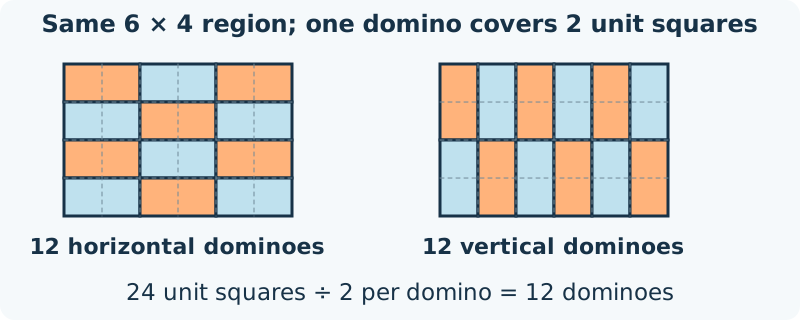
Draw three horizontal dominoes across each row. Repeat that row four times. Trace the outline of each tile so the unit grid does not hide where one tile ends.
Check placement and count
Check every one of the 24 unit squares belongs to exactly one tile. Four rows with three dominoes give 12 tiles; 12 × 2 = 24 unit squares.
Try another arrangement
Turn all dominoes vertically. Each column now has two dominoes, and six columns still use 12. Describe the changed placement and unchanged coverage, or keep just the first arrangement.
One possible version
Constructed example: two ways to cover 24 squares
These are original drawn arrangements, not a record of a real tiled floor.
- Horizontal: 3 dominoes per row × 4 rows = 12 dominoes.
- Vertical: 2 dominoes per column × 6 columns = 12 dominoes.
- Both cover 12 × 2 = 24 unit squares without cutting tiles. The drawn placement, as well as the area count, checks this region.
Matching total area is necessary here, but does not by itself prove that any other board can be tiled. The shape and placement also matter.
Something to keep?
Did I check the actual placement as well as the total area?
You can keep a question, a sketch or a change of mind. A finished product is optional.
This opens an editable starter in your project tools. It asks before replacing open work. Choosing it does not save or share your work automatically.