
Zoology · Investigate
A beak drawing and a function question
What can shape alone suggest, and what needs a checked reference?
Compare two original beak models numerically, then separate a visible feature from a claim about how a bird lives.
15–25 minutes, or one comparison for a first try. More time is optional.
Start here
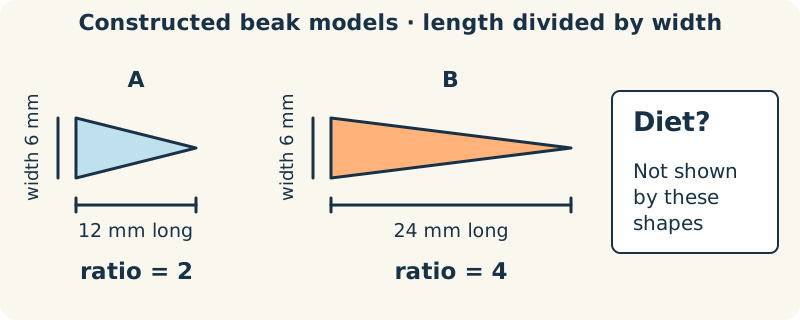
Use two fictional beak models measured by the same drawing convention: A is 12 mm long and 6 mm wide; B is 24 mm long and 6 mm wide. These are model labels, not measurements of real birds.
Use your idea or the example below. Talk, write, draw, point or listen first. You can stop after one step.
Try it your way.
Compare like measurements
Keep units and measurement points consistent. Length-to-width ratio is length divided by width: A = 12 / 6 = 2; B = 24 / 6 = 4.
State what the drawing supports
B is twice as long in this model and has twice A’s length-to-width ratio. Both have the same stated width. This is a shape comparison, not an identification.
Question a function claim
The silhouette might suggest a question about reach or handling food, but it does not establish a diet. Real beaks serve several functions, and similar shapes need not be used in exactly the same way.
Name better evidence
For a real species question, seek a checked species reference and observations of what that species does. You can finish by stating what evidence is missing; do not catch, feed or test a bird.
One possible version
Two ratios, no invented diet
Both outlines and all dimensions are original constructed models.
- A: 12 mm/6 mm = 2. B: 24 mm/6 mm = 4. These ratios have no unit because the same units cancel.
- B’s model length is 2 × A’s. The figures alone do not prove B eats a particular food or has greater feeding success.
- A useful question is “What evidence would connect this feature with a function in a named species?” It is more precise than assigning a diet to an unnamed drawing.
Model dimensions do not reveal material properties, movement, ancestry, behaviour or ecological context. The reference research does not validate these fictional beaks.
Something to keep?
Which part of my account came from the model, and which would require evidence about a real species?
You can keep a question, a sketch or a change of mind. A finished product is optional.
This opens an editable starter in your project tools. It asks before replacing open work. Choosing it does not save or share your work automatically.