
Zoology · Make
Invent a creature with a labelled inspiration
Which movement idea is researched and which part belongs to invention?
Design an imaginary creature while labelling what came from research and what is only an untested invention.
15–25 minutes, or one comparison for a first try. More time is optional.
Start here
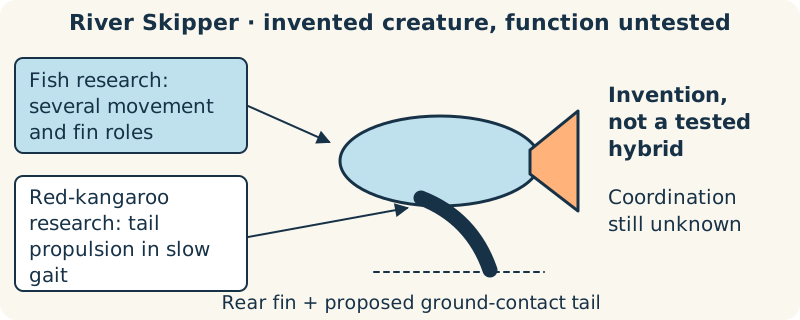
Sketch an invented “River Skipper”: an oval body, a side-to-side rear fin and a muscular tail that might contact the ground. Label the whole creature “invented; function untested”.
Use your idea or the example below. Talk, write, draw, point or listen first. You can stop after one step.
Try it your way.
Read the two supplied research notes
The Florida Museum describes different ways fish propel and stabilise themselves, including body/tail motion. A red-kangaroo study measured a propulsive role for the tail during its slow five-part gait. These are different real cases.
Mark the borrowed ideas
Label rear-fin movement “inspired by fish locomotion” and proposed ground-contacting tail “inspired by the red-kangaroo study”. These labels identify an inspiration, not evidence that a hybrid would work.
Add one invented feature
For example, give the creature broad folding fins. Explain their proposed purpose with “might”. Write one unanswered question about support, movement or coordination; do not describe the proposal as an observed adaptation.
Keep the categories separate
Use three headings: researched statement, design invention, evidence still needed. The paper creature is complete as a labelled idea, even when its physical feasibility remains unknown.
One possible version
A research-inspired drawing with honest labels
The River Skipper is original fiction; no animal was made, measured or observed for this activity.
- Research: some fish use body/tail movement in swimming. The museum also describes fins helping with stability and manoeuvring, so “all fins do the same job” would be inaccurate.
- Research: the cited red-kangaroo work concerns slow pentapedal locomotion; it does not establish a universal function for every animal’s tail.
- Invention: one creature combines a rear fin with a proposed ground-contact tail. Unknown: whether its structures, materials and movement could work together.
A useful biological analogy is not proof of engineering feasibility, evolutionary history or real animal behaviour. Keep the inspiration’s species and movement context visible.
Something to keep?
Can a reader tell exactly which statement is researched and which part I invented?
You can keep a question, a sketch or a change of mind. A finished product is optional.
This opens an editable starter in your project tools. It asks before replacing open work. Choosing it does not save or share your work automatically.