
Zoology · Explore
Sort animal clues without guessing
What happens when a grouping rule meets a missing detail?
Group four fictional animal cards by stated features, change the rule and keep unknown information visible.
10–20 minutes, or one grouping for a first try. More time is optional.
Start here
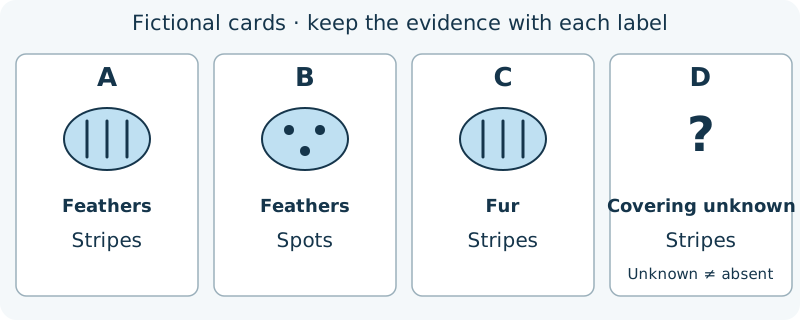
Copy four labels, or use the supplied cards: A has feathers and stripes; B has feathers and spots; C has fur and stripes; D has stripes but its covering is hidden.
Use your idea or the example below. Talk, write, draw, point or listen first. You can stop after one step.
Try it your way.
Keep the evidence attached
These are invented creatures described for a sorting model, not real species records. Record only what each description supplies. For D, ‘covering hidden’ means unknown, not ‘no covering’.
Choose one rule
First group by the stated covering: feathers, fur or unknown. Put A with B, C in fur and D in unknown. You can draw boxes, point or say the groups instead of making cards.
Change the question
Now group by stated pattern: stripes or spots. A, C and D go together for stripes; B has spots. This grouping answers a different question, so changing groups is not a contradiction.
Name a limit
Write one conclusion supported by the descriptions and one question they cannot answer, such as how the animals move. Do not fill a missing detail with a guess. You may design an additional fictional card if you want.
One possible version
Four fictional cards, two sensible groupings
The supplied model descriptions are complete: A = feathers, stripes; B = feathers, spots; C = fur, stripes; D = stripes, covering hidden. These labels are invented, not observations of actual animals.
- Covering rule: feathers A/B; fur C; unknown D.
- Pattern rule: stripes A/C/D; spots B.
- D can join the striped group while its covering remains unknown. One known feature does not supply a missing one.
These convenient groups do not identify a species, establish evolutionary relationships or prove a feature's function. No animal contact or collection is part of this activity.
Something to keep?
Did I keep ‘unknown’ different from ‘absent’?
You can keep a question, a sketch or a change of mind. A finished product is optional.
This opens an editable starter in your project tools. It asks before replacing open work. Choosing it does not save or share your work automatically.